Aquarius — Astrological Predictions for 2027
Discover the major astrological trends of 2027 for the three decans of Aquarius: planetary transits, eclipses, and major transformations based on the positions of your natal planets.
The year 2027 is set to be a period of significant change for those whose personal planets are in Aquarius. These predictions are therefore not limited to people born under this sign: they apply to anyone with the Sun, Moon, Mercury, Venus, or Mars in Aquarius.
Depending on the planet involved and its exact degree, you may experience very different processes. Some transits will affect your identity, others your habitual emotional responses, your thinking, your value system, or your deepest motivations.
Throughout the year, personal planets in Aquarius will receive aspects from Jupiter, Saturn, Uranus, Neptune, and Pluto. These will be accompanied by Mars’s retrograde cycle, Lilith’s entry into Aquarius, and several significant eclipses.
Let us examine the three decans of Aquarius separately. However, refer above all to the degrees of your natal planets: the influence of an aspect does not end strictly at the boundary of a decan.
First Decan of Aquarius (January 20–29): A Profound Transformation
For the first decan, 2027 is particularly marked by the influence of three trans-Saturnian planets: Pluto, Neptune, and Uranus.
Pluto continues its journey through Aquarius, forming conjunctions with personal planets in the first decan. Planets positioned approximately between 4° and 7° Aquarius are particularly affected. On May 8, Pluto turns retrograde before resuming direct motion on October 17. Certain psychological themes may therefore resurface over several months, gradually revealing new dimensions of the transformations already underway.
A Pluto conjunction is one of the most profoundly transformative transits. It can dismantle old inner structures that, although once useful, have become limitations.
It is important to understand that Pluto does not simply deprive a person of their familiar points of reference. Its role is to lead them to question the very foundations of those reference points, release the energy devoted to maintaining outdated patterns, and redirect it toward building a new reality.
When Pluto is conjunct the natal Sun, this may manifest as a profound identity crisis. Old perceptions of oneself, one’s abilities, creative expression, and vocation may no longer correspond to one’s inner needs. This is when fundamental questions begin to arise: Who am I really? What do I truly want? Why should I continue to conform to an image that no longer represents me?
This process can create intense inner tension. Letting go of an old identity means, to some extent, leaving behind a familiar version of oneself. Yet this is precisely where an immense potential for renewal lies. By going through this crisis, a person may reach an entirely new level of personal fulfillment, discover talents they previously did not dare to express, and develop a much greater sense of inner independence.
Since the Sun is also associated with the father figure, one’s relationship with paternal authority and the principles of life passed down through it may also undergo transformation.
When Pluto is conjunct the natal Moon, changes affect a deeper, more instinctive level of the psyche. Familiar ways of finding comfort and emotional security may cease to work. It becomes necessary to reassess one’s relationship with the past, the maternal figure, and the inner patterns formed over the years.
This period can also be difficult. However, it offers an opportunity to free oneself from emotional dependencies and habitual reactions that have limited one’s freedom of choice. New sources of inner stability can then be developed. Since the Moon is also a significator of professional orientation, this transformation may change one’s relationship with one’s professional activity.
If Pluto is conjunct Mercury, thinking undergoes a restructuring. Old intellectual frameworks may begin to feel too restrictive. One starts exploring information more deeply, questioning conventional explanations, and developing a more independent worldview.
When Pluto is conjunct Venus, it brings about a reassessment of values, attachments, and the principles of exchange within relationships. Sometimes, it becomes necessary to let go of relationships or beliefs that no longer correspond to one’s inner evolution. However, this detachment opens the way to more mature and profound connections.
Finally, Pluto’s conjunction with Mars affects deep-seated motivations. One may realize that former goals no longer inspire enthusiasm and that familiar ways of struggling require too much energy. This is an opportunity to discover a new source of strength and learn to use one’s energy more consciously.
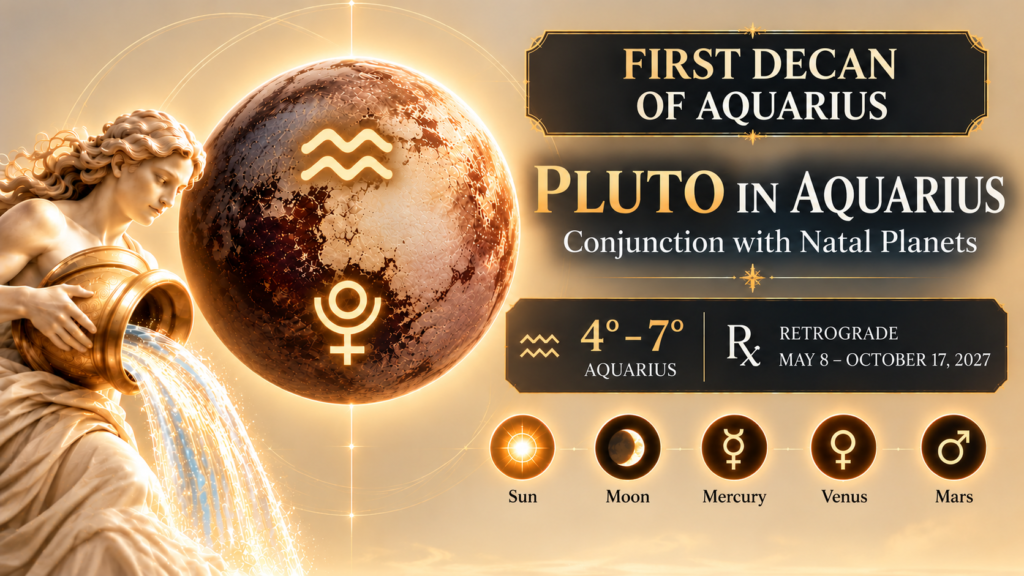
Neptune and Uranus: New Opportunities for Renewal
But Pluto does not act alone. Throughout the year, Neptune in Aries forms sextiles to personal planets in the first decan of Aquarius, particularly those positioned approximately between 4° and 7°. From July to December, its retrograde phase brings attention back to the corresponding psychological processes.
This combination is particularly interesting. Pluto demands profound transformation, while Neptune encourages greater flexibility, an awareness of hidden processes, and the adoption of indirect strategies. Rather than trying to control everything through direct effort, one can learn to act with greater subtlety, view events from a different perspective, and recognize possibilities that had previously gone unnoticed.
Uranus also contributes to this configuration. As it moves through Gemini, it forms trines to the first decan of Aquarius. On February 8, Uranus ends its previous retrograde phase, then turns retrograde again on September 15.
For certain degrees of the first decan, several trans-Saturnian influences may therefore affect the same natal planet. Pluto calls for inner transformation, Neptune suggests changing one’s approach to events, and Uranus opens up possibilities for intellectual renewal, liberation from old patterns, and the search for original solutions.
Such periods can bring about a genuine qualitative leap. It is not simply a matter of changing a few habits, but of beginning to perceive oneself and reality in an entirely new way.
Harmonious aspects, however, do not mean that everything will happen automatically. Uranus’s trine opens up possibilities, and Neptune’s sextile offers new qualities to develop, but it is up to each individual to make conscious use of them.
August 2: A Solar Eclipse and the Possibility of a New Beginning
On August 2, a total solar eclipse occurs at 9°55′ Leo. It forms an opposition to natal planets positioned around 10° Aquarius. With an orb of up to 6°, its influence may extend approximately from 4° to 16° Aquarius, covering the end of the first decan and the beginning of the second.
A solar eclipse is associated with the renewal of life patterns. It represents a kind of reset, an opportunity to initiate an entirely new trend. However, the nature of this renewal depends on the aspect formed between the eclipse point and the natal planet.
In this case, it is an opposition. An opposition implies the need to make a choice and may mark the culmination of previous developments. To make way for something new, it is sometimes necessary to let go of an old belief, an attachment, a familiar role, or a goal that has outlived its purpose.
This choice can be stressful. Even an unsatisfactory situation remains familiar and predictable, while a new path requires courage. Yet it is precisely by freeing oneself from old constraints that one becomes able to direct one’s energy in an entirely different direction.
It is particularly interesting to note that personal planets positioned around 9°–10° Aquarius may simultaneously receive the opposition from the solar eclipse and the trine from Uranus in Gemini.
The eclipse therefore raises the question of a necessary choice, while Uranus offers new possibilities for putting that choice into practice. This may correspond to an intellectual breakthrough, an unexpected shift in perspective, or liberation from something that has long seemed unchangeable.
If the eclipse opposition affects the natal Sun, it may become necessary to reassess one’s identity, creative projects, and understanding of one’s vocation. Sometimes, a new chapter begins when one lets go of an old self-image. This is not easy, but it creates the space needed for more independent and complete personal fulfillment.
If the aspect affects the Moon, it may be necessary to reconsider habitual emotional reactions, familiar ways of finding comfort, and one’s relationship with the past. One may feel the need to stop living according to old inner patterns. This is an opportunity to develop new habits and establish more independent emotional foundations.
The opposition to Mercury may require letting go of outdated beliefs; to Venus, a reassessment of values and relationship principles; to Mars, a change in motivations and the ways one pursues one’s goals.
The August solar eclipse may therefore represent an important turning point for part of the first decan. However, the direction of this turning point will largely depend on each individual’s willingness to consciously bring an old chapter to a close.
Would you like to learn how to analyze natal charts yourself and make astrological predictions? I invite you to join my School of Natal and Predictive Astrology, where you can master professional methods of astrological chart analysis and forecasting.
Natal Astrology
Learn to interpret a natal chart and create an astro-psychological profile: motivations, dependencies, blockages, and fears. Discover the keys to understanding and developing each person’s potential, talents, and personal resources.
Predictive Astrology
Master the five fundamental predictive techniques to make accurate astrological forecasts. Learn to correct negative trends and discover the principles of electional astrology to choose the most favorable time for your projects.
Second Decan of Aquarius (January 30 – February 8): Reassessing Beliefs and Opening New Horizons
For the second decan, one of the major influences of 2027 is Jupiter, which remains in Leo until July 25 and forms oppositions to the corresponding degrees of Aquarius.
On April 12, Jupiter ends its retrograde phase. Its retrograde cycle is particularly important for those with personal planets positioned approximately between 15° and 19° Aquarius. As Jupiter activates these degrees several times, certain issues may resurface and require deeper reflection.
Jupiter is associated with the expansion of opportunities, expertise, authority, and one’s understanding of personal development. However, its opposition may reveal that not every form of expansion is necessarily beneficial. Sometimes, we seek to achieve more simply because we have become accustomed to measuring our success through external accomplishments.
In this case, Jupiter’s opposition calls for a reassessment of priorities. What should you let go of? Which ambitions no longer align with your needs? Which goals truly deserve your time and energy?
This choice can be difficult, especially when you have already invested a great deal in a particular direction. However, letting go of excessive expectations can free up tremendous resources for more promising growth.
February 6: A Solar Eclipse at 17°37′ Aquarius
On February 6, an annular solar eclipse occurs at 17°37′ Aquarius. With an orb of up to 6°, it affects personal planets positioned approximately between 12° and 24° Aquarius, covering the second decan and the beginning of the third.
Unlike the August eclipse in Leo, which forms an opposition to planets in Aquarius, the February eclipse forms a conjunction with them.
This difference is fundamental.
A conjunction with a solar eclipse offers the possibility of resetting the functions of the natal planet. It is less about letting go of an opposing principle and more about beginning a new cycle, renewing one’s life patterns, and creating entirely new scenarios.
If the eclipse is conjunct the natal Sun, it offers an opportunity to renew one’s sense of identity, vocation, and creative self-expression. A period may begin in which one wishes to live more independently, reveal one’s abilities, and stop conforming exclusively to the expectations of others.
If the conjunction affects the Moon, the new cycle may concern emotional life, family patterns, one’s relationship with the maternal figure, and familiar ways of finding comfort. New sources of inner stability may develop, along with new conditions for emotional security. Given the Moon’s role in career choice, one’s vision of the professional activity one wishes to pursue may also evolve.
When the eclipse is conjunct Mercury, new intellectual possibilities emerge. One may become interested in new areas of knowledge, change the way one learns, reassess one’s beliefs, or discover an entirely different direction for intellectual development.
When the eclipse is conjunct Venus, the reset affects one’s value system, perceptions of attraction and pleasure, and the principles of exchange within relationships. One may be ready to begin a new relationship or renew an existing one, primarily through the evolution of one’s own values.
When the eclipse is conjunct Mars, a new phase begins in the realm of deep-seated motivations. One may discover new goals, feel the desire to act differently, and direct one’s energy toward what truly aligns with one’s inner aspirations.
However, it is important to understand that a solar eclipse does not guarantee immediate results. It initiates a new trend that may develop gradually. The more consciously one approaches these changes, the greater the opportunities to create a new life scenario.
The Solar Eclipse and Jupiter’s Opposition
It is particularly interesting to note that the February eclipse and Jupiter’s station in the spring activate practically the same area of Aquarius.
A person with a personal planet around 17° Aquarius may therefore experience two successive influences: the solar eclipse conjunction and Jupiter’s opposition.
The solar eclipse marks the beginning of a new cycle, while Jupiter raises questions about its direction and scope. Which opportunities are truly worth developing? Which beliefs will help you move forward, and which will limit you? What excessive expectations must you let go of to give this new life pattern a solid foundation?
If these influences affect the Sun, a profound reassessment of one’s vocation and understanding of success may begin. For the Moon, the renewal of emotional needs may be accompanied by a reassessment of career direction. For Mercury, intellectual beliefs come to the forefront; for Venus, values and relationships; and for Mars, ambitions and deep-seated motivations.
Saturn provides additional support to certain degrees of the second decan through its sextiles from Aries. Its principle is associated with discipline, perseverance, and the ability to build lasting structures.
Jupiter encourages us to define the direction to follow, the solar eclipse initiates a new cycle, and Saturn offers the possibility of giving it solid foundations.
Thus, even a period of tension can become the starting point for a major qualitative transformation.
Third Decan of Aquarius (February 9–18): Releasing Your Energy and Bringing Old Patterns to a Close
For the third decan, 2027 is particularly marked by Jupiter’s oppositions, Mars’s retrograde cycle, Saturn’s sextiles, and eclipses that activate the corresponding degrees.
At the beginning of the year, Jupiter continues its retrograde motion in Leo, forming oppositions to natal planets in the third decan of Aquarius. Meanwhile, Mars turns retrograde on January 10. In February, it returns to Leo, resumes direct motion on April 1, and then moves back into Virgo in May.
Thus, in late February and March, Mars forms oppositions to personal planets in the third decan of Aquarius. For certain degrees, these influences may occur repeatedly, as Mars passes through the same sections of the sign in different directions.
Jupiter and Mars affect distinct psychological functions. Jupiter is associated with the scope of one’s goals, expertise, and the expansion of opportunities, while Mars represents deep-seated motivations, ways of taking action, and the expenditure of energy.
Oppositions to personal planets may reveal that one continues to invest energy in goals that no longer correspond to one’s needs. Sometimes, we continue a struggle simply out of habit, without realizing that the goal itself has long since lost its meaning.
An opposition invites us to stop and make a choice. Letting go of an old strategy may certainly cause disappointment, inner resistance, or a sense of loss. However, it can actually release a considerable amount of energy.
Instead of endlessly repeating an old conflict, one can devote one’s energy to entirely new goals.
If Mars’s opposition affects the Sun, it may become necessary to abandon old ways of asserting oneself and reassess one’s creative goals. If it affects the Moon, it may involve changing instinctive reactions and defense mechanisms that no longer provide emotional stability.
If the aspect affects Mercury, a reassessment of intellectual positions and ways of debating may be necessary. For Venus, it may involve abandoning ineffective principles of exchange in relationships; for natal Mars, a profound reassessment of one’s motivations, ways of dealing with conflict, and allocation of energy.
Mars’s retrograde cycle makes this process particularly interesting. Certain issues may resurface, as though offering several opportunities to change an old strategy.
The essential thing is not to view tensions solely as obstacles. Sometimes, they become the necessary driving force behind a genuine breakthrough.
February 6: The Beginning of a New Cycle
The solar eclipse on February 6 at 17°37′ Aquarius may affect not only the second decan but also the beginning of the third, up to approximately 24° Aquarius with an orb of 6°.
If the eclipse is conjunct one of your natal personal planets, it opens up the possibility of renewing its psychological function. For the Sun, this means a new phase of self-assertion; for the Moon, a renewal of emotional patterns; for Mercury, intellectual patterns; for Venus, values and relationship principles; and for Mars, motivations and ways of taking action.
However, for the third decan, the second half of the year is particularly significant.
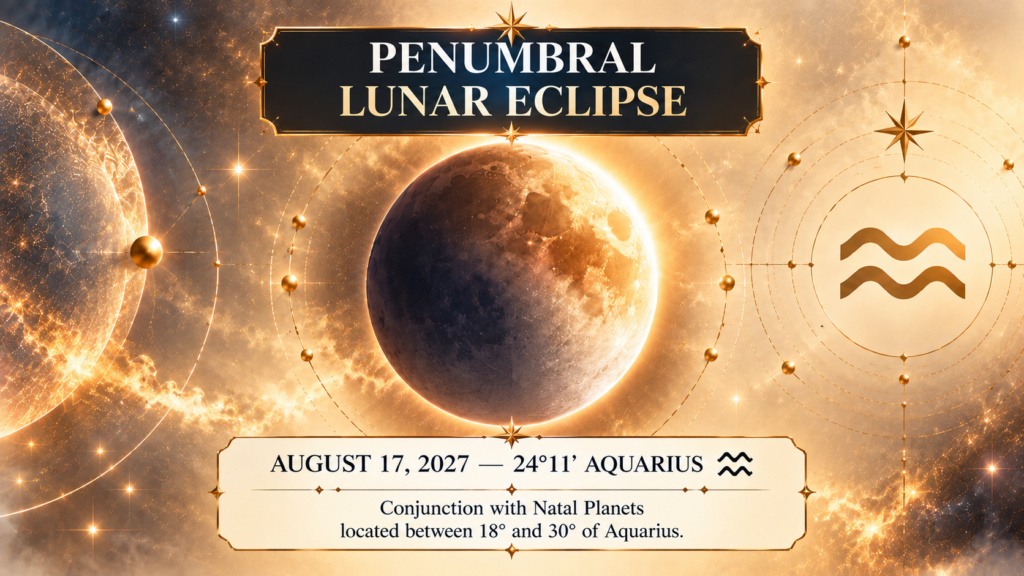
August 17: A Lunar Eclipse at 24°11′ Aquarius
On August 17, a penumbral lunar eclipse occurs at 24°11′ Aquarius. With an orb of up to 6°, it affects natal planets positioned approximately between 18° and 30° Aquarius, covering almost the entire third decan and the end of the second.
It is important to understand the fundamental difference between a lunar eclipse and a solar eclipse.
While a solar eclipse opens a new cycle, a lunar eclipse is associated with the culmination of previous processes, taking stock of what has been accomplished, and bringing to completion what has already run its course.
This is a time to reap the rewards of one’s efforts. One may see the results of past decisions, become aware of the consequences of the chosen strategy, and understand which processes have reached their natural conclusion.
Not everything that comes to an end represents a loss. Sometimes, an ending marks the successful completion of a long phase; at other times, it means letting go of something that no longer holds any prospects.
If the lunar eclipse is conjunct the natal Sun, processes related to identity, creative self-expression, and one’s understanding of one’s vocation may reach their culmination. One may see the results of the preceding period and decide which directions to pursue and which to leave behind.
If the eclipse is conjunct the Moon, taking stock of one’s emotional life becomes particularly important. Familiar ways of finding comfort, one’s relationship with the past, the maternal figure, and career direction may require reassessment. This is an opportunity to bring to a close emotional patterns that have long determined one’s behavior.
When the eclipse is conjunct Mercury, a phase of intellectual development may come to an end. One takes stock of what one has learned, reassesses one’s beliefs, frees oneself from outdated perceptions, and prepares to reach a new level of knowledge.
If the eclipse is conjunct Venus, the culmination concerns values and relationships. Some relationships may enter a new phase, while others may come to an end if the old principles of exchange have run their course. In both cases, it becomes possible to better understand one’s needs and build more mature relationships.
When the eclipse is conjunct Mars, the time has come to evaluate the results of past actions. Were the efforts made justified? Which goals have been achieved? Which ways of dealing with conflict no longer make sense? Completing old tasks frees up energy for new ones.
The lunar eclipse should therefore not be viewed solely as a period of loss. It is a time to release what has run its course, take stock of what has been accomplished, and prepare for a new phase of life.
Saturn: Consolidating the Changes Made
In August, Saturn in Aries turns retrograde before resuming direct motion on December 23. During the second half of the year, it forms sextiles to much of the third decan of Aquarius.
This is particularly interesting for those with personal planets positioned approximately between 21° and 28° Aquarius. They may experience the conjunction of the August lunar eclipse and Saturn’s sextile within a relatively short period.
The lunar eclipse encourages taking stock and bringing old processes to a close, while Saturn helps give lasting form to the changes that have taken place. Its sextile offers an opportunity to develop discipline, a sense of responsibility, perseverance, and the ability to establish long-term structures.
If, for example, the natal Moon is positioned around 24° Aquarius, the August eclipse may highlight the need to bring old emotional patterns to a close. At the same time, Saturn’s sextile offers an opportunity to establish new habits and a more stable sense of inner security.
If Venus is positioned at this degree, the end of an old phase involving values or relationships may be accompanied by the development of more mature relationship principles. For Mercury, this is an opportunity to organize accumulated knowledge; for Mars, to channel released energy into consistent, forward-looking actions.
In August, Mars also moves through Libra, forming trines to the corresponding degrees of Aquarius. For some people with personal planets in the third decan, this provides an additional opportunity to translate inner transformations into concrete actions.
This illustrates an important principle of predictive astrology: challenging and harmonious aspects can operate during the same period, presenting different tasks. Some call for an ending or letting go, while others open up opportunities to build a new reality.
Lilith in Aquarius: June 11, 2027 – March 7, 2028
On June 11, Lilith enters Aquarius and will remain there until March 7, 2028. It may intensify the shadow expressions of this sign: the pursuit of absolute freedom, rebellion, rejection of restrictions, irresponsibility, and the desire to destroy the established order.
It is particularly important to check whether transiting Lilith will form a conjunction with your personal planets in Aquarius. Such conjunctions may activate unconscious processes, hidden desires, and temptations, intensifying the lower expressions of the planet involved.
The challenge during this period is to become aware of one’s inner contradictions, resist destructive impulses, and learn to channel the desire for freedom and change in a constructive way.
Autumn and the End of 2027
The final months of the year will be particularly important for the continuation of processes that began earlier.
On September 15, Uranus turns retrograde and continues to activate the end of the first decan of Aquarius through a trine. This is particularly significant for those with personal planets around 10° Aquarius, following the August solar eclipse, which formed an opposition to these same degrees.
On October 17, Pluto resumes direct motion. For those with personal planets near 5° Aquarius, the profound transformation of the corresponding psychological functions continues. However, it becomes possible to gain a clearer understanding of which inner structures need to be abandoned and which opportunities are opening up as a result of the ongoing changes.
On December 15, Neptune ends its retrograde phase and once again activates the early degrees of Aquarius through a sextile. Then, on December 23, Saturn turns direct, drawing attention once again to the beginning of the third decan.
The end of the year thus highlights the differences between the decans once again.
For the first decan, the major themes remain transformation, renewal of thinking, and the search for new ways of interacting with reality. For the second, the focus is on reassessing beliefs, life directions, and opportunities for growth. For the third, it is about freeing oneself from outdated motivations, bringing old patterns to a close, and establishing more stable inner principles.
Challenging aspects do not necessarily indicate unfavorable events. They often serve as a powerful driving force for development: letting go of outdated beliefs, habits, or relationships releases energy to create an entirely new reality.
Social and trans-Saturnian planets may repeat the same aspect to a natal planet three to five times. It is therefore useful to check their transits in 2026 and 2028 as well: changes generally stabilize after the entire retrograde cycle has been completed.
What Else Should Be Taken into Account in an Individual Astrological Forecast?
We have examined the main transits and eclipses that may influence personal planets in Aquarius. However, these represent only part of a complete astrological forecast.
To understand the specific areas of life in which these processes may manifest, we must consider the houses of the natal chart in which the planets receiving the aspects are located, as well as the houses they rule. These factors add an event-related dimension to the psychological interpretation.
Furthermore, transits of social and trans-Saturnian planets can form aspects not only to the natal Sun, Moon, Mercury, Venus, and Mars, but also to natal Jupiter, Saturn, Uranus, Neptune, and Pluto. In such cases, we primarily examine the potential developments and events indicated by the houses in which the affected natal planets are positioned and the houses they rule.
But that is not all. To produce a comprehensive forecast, transits and eclipses must be considered alongside other predictive techniques: secondary progressions, symbolic directions, and the solar return. It is the combination of these methods that provides a more complete picture of the period ahead.
If you would like to know how the transits of 2027 may manifest in your life, which areas will be most active, and what opportunities or challenges this period may bring, I invite you to book an individual astrological consultation.
Using your exact date, time, and place of birth, we can analyze not only the influence of the planets on your inner world, but also specific potential events and developments, taking into account all the relevant indicators in your natal chart and the appropriate predictive techniques.